 English
 简体中文
简体中文
 Deutsch
 Español

Leak Test Methods
Temperature Effects on Part Testing in the Medical Device Sector
The relationship between pressure drop, leak rate and volume is derived from the basic gas law.
In high-throughput manufacturing environments, leak testers are indispensable tools for product quality and regulatory compliance. However, even the most accurate instruments can experience calibration drift or fall out of tolerance (OOT) over time, especially in demanding production settings.
When a leak tester fails calibration, it raises immediate concerns about measurement accuracy, testing reliability, and product quality. The good news? With the right strategy in place, OOT conditions can be anticipated, identified early, and managed effectively.
When testers fall out of tolerance, it's essential to isolate the root cause and determine whether the issue affects functional performance or simply the instrument’s reference baseline.
Preventing OOT conditions isn’t about over-correcting, it's about smart, preventative system management. Based on technical evaluations, the most effective mitigation measures focus on three main areas:
An important concept in leak testing is that a tester can still make valid decisions, even with a reported pressure offset.
If both the starting pressure (P1) and final pressure (P2) are affected equally by an offset (P’), the differential remains unchanged:
ΔP = (P1 + P’) – (P2 + P’) = P1 – P2
This means that while the absolute pressure reading may be slightly off, the leak detection outcome is still correct. In most cases, this has a negligible impact on product testing or process integrity.
It’s still important to investigate and resolve any OOT finding, but this concept offers reassurance that detection logic remains reliable in many real-world cases.
To maintain long-term measurement integrity, several low-effort but high-impact strategies can be implemented:
The best defense against unexpected calibration issues is a strong verification strategy. Leak testers are precise, dynamic systems that benefit from attention between calibration cycles, not just during them.
Best Practices for Long-Term Accuracy:
These steps help safeguard product quality, reduce downtime, and ensure consistent compliance, regardless of the size or complexity of your operation.
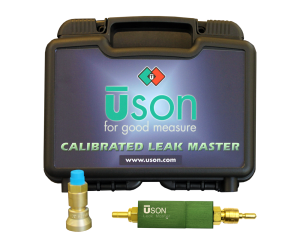
 Uson technical experts are here to support your leak test verification strategy, from preventative maintenance plans to tool recommendations like Leak Masters.
Contact Uson Technical Support or give us a call 📞: +1 281-671-2000 to learn more.
The relationship between pressure drop, leak rate and volume is derived from the basic gas law.
Fuel pressure regulators plays a direct role in the distribution of fuel to the engine. There are several leak test method options to test this...
Automation Director simplifies leak test sequencing by reducing PLC code, cutting FAT risk, and boosting consistency across projects.