Why Medical Device Leak Testing Should Start Long Before Production
The most important leak test isn't the one you perform on the production line, it's the one you plan during product development.
As medical devices become smaller, more sophisticated, and increasingly critical to patient care, leak testing has evolved from a manufacturing quality check into an essential engineering discipline. The decisions made during the design phase; how a leak rate is defined, which test method is selected, and how the process is validated can influence product quality, manufacturing efficiency, and ultimately, patient safety.
The challenge is that these decisions are often difficult to reverse once production begins.
Leak Integrity Defines Patient Safety
Every medical device has a purpose, whether it's delivering medication, supporting cardiovascular function, monitoring glucose levels, or enabling minimally invasive procedures. Regardless of its application, one thing remains constant:
Leak integrity matters.
A leak that goes undetected can compromise device performance, sterility, or reliability. Conversely, an overly sensitive or poorly designed leak test can reject perfectly good products, driving unnecessary scrap, production delays, and increased manufacturing costs.
Finding the right balance requires more than selecting a tester, it requires understanding the application, defining realistic leak-rate specifications, and validating the entire testing process.
The Two Questions Every Engineer Must Answer
During new product development, engineering teams consistently face two critical questions:
- What leak rate should this device be designed to meet?
- How can that leak rate be verified consistently throughout manufacturing?
These questions influence every stage of development, from prototype evaluation to full-scale production.
Getting them right early helps eliminate costly redesigns and production issues later. That's why establishing a robust leak-testing strategy during development is just as important as the final production test itself.
Leak Testing Is More Than Choosing an Instrument
One of the most common misconceptions is that leak testing begins with selecting equipment. In reality, successful leak testing begins with understanding:
Each of these factors contributes to the reliability of the final result. A well-designed testing process minimizes variation while providing confidence that every device leaving production meets its intended performance requirements.
Why Good Parts Sometimes Fail
One of the biggest frustrations for manufacturing teams is the occurrence of false fails.
A pressure drop during testing doesn't always indicate a leaking device. Thermal drift, material creep in flexible polymers, and fixture instability can all mimic the behavior of a leak, causing acceptable parts to be rejected unnecessarily.
Understanding these variables and designing test methods that account for them can significantly improve production yields while maintaining product quality.
Selecting the Right Leak Test Method
There is no universal leak-testing method that works for every medical device.
Depending on the application, engineers may choose from techniques such as:
Each approach offers different advantages depending on device geometry, internal volume, required sensitivity, production speed, and validation requirements. Selecting the appropriate method early in development helps avoid unnecessary compromises later in production.
Supporting Engineers from Prototype to Production
Successful leak testing doesn't stop after the first prototype passes inspection.
As devices move toward commercialization, engineering teams must ensure that testing remains consistent across manufacturing lines, facilities, and even global production sites.
That requires:
-
Defining realistic leak-rate specifications
-
Balancing manufacturing feasibility with product performance
-
Maintaining consistency across production facilities
- Reducing testing variability and unnecessary scrap
These are challenges that extend well beyond equipment selection, they require application expertise and practical engineering experience.
Engineering Knowledge That Makes a Difference
Medical device leak testing continues to evolve alongside increasingly complex devices and tighter quality expectations. Engineers need practical resources that help them make informed decisions, troubleshoot challenging applications, and build reliable validation processes.
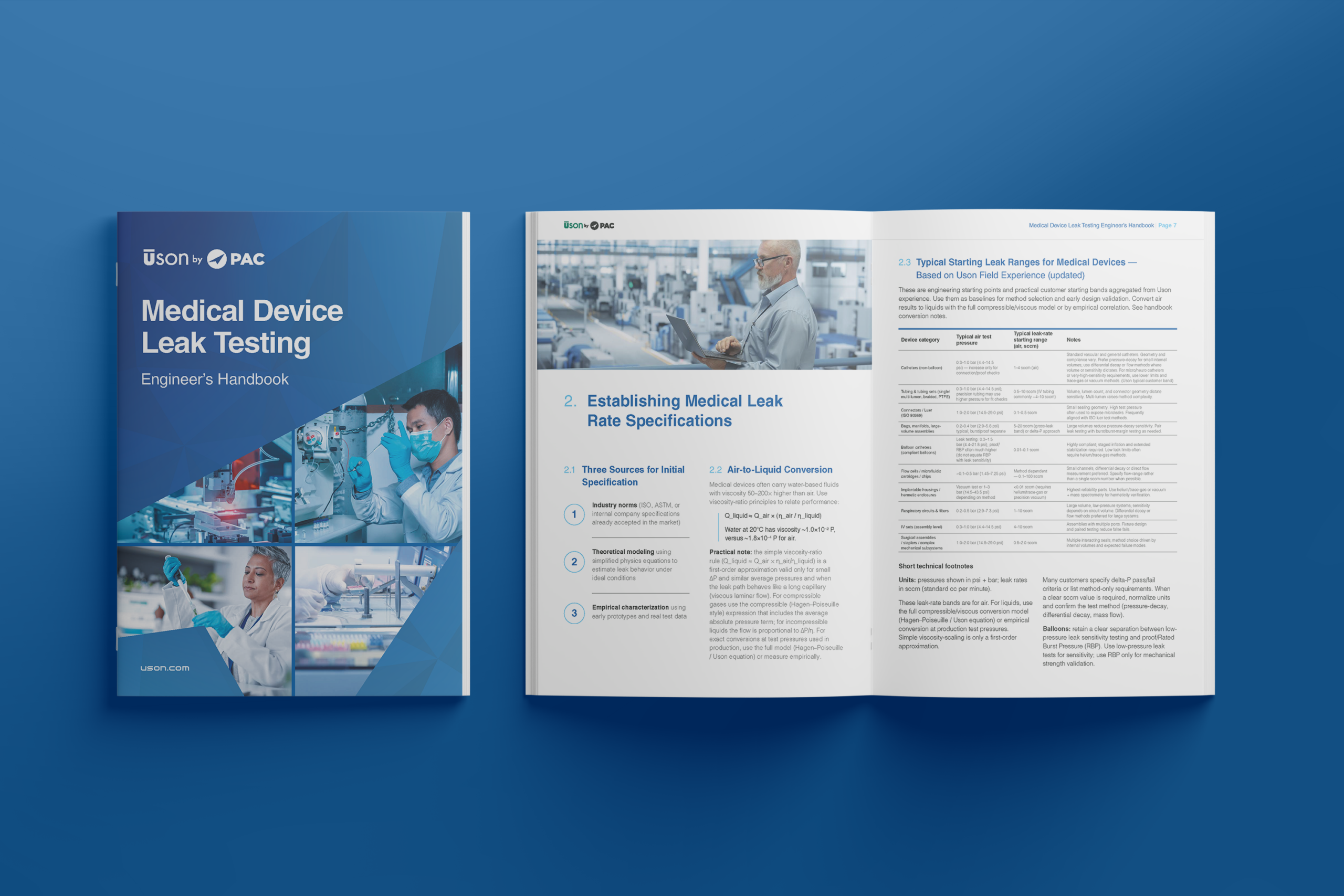
That's why Uson by PAC developed the Medical Device Leak Testing Engineer's Handbook, a practical reference built from decades of application engineering experience. Designed for R&D and product development teams, it provides guidance on establishing leak-rate specifications, selecting the appropriate test method, preventing false fails, designing effective fixtures, and validating leak-testing processes.
Download the Free Engineer's Handbook
Whether you're developing a new medical device or optimizing an existing manufacturing process, the right leak-testing strategy can save months of development time and improve long-term product quality.
Download the Medical Device Leak Testing Engineer's Handbook to gain practical insights from Uson by PAC's application engineering experts and build a leak-testing process that delivers confidence, from concept through production.
_____________________________________________________________________________________________________________________
Need Expert Guidance?

Contact us at www.uson.com or schedule a demo to see the Astra Dash in action.
If you need immediate assistance with an application or project, don't hesitate to reach out to our team. Click here to email us or call us at +1-281-671-2000.
Let us know how we can help!
 English
 简体中文
简体中文
 Deutsch
 Español